


In our first Pillar 4 post, we confronted the crisis: falls are the leading cause of injury-related death in older adults, killing over 43,000 Americans in 2024 alone. We showed that falls are not random accidents but predictable failures of multiple physical systems — muscle strength, cardiovascular fitness, mobility, and balance — declining simultaneously below critical thresholds.
Now we get specific. If falls are a systems problem, then single-leg stability is the canary in the coal mine — the earliest, most sensitive indicator that the system is beginning to fail. And proprioception — the body’s ability to sense where it is in space — is the invisible infrastructure that makes single-leg stability possible.
The argument for building both early — not in your 70s when balance is already compromised, but in your 30s, 40s, and 50s when the neural pathways are still robust and trainable — is one of the most practically important in this entire series.
The 10-Second Test That Predicts Your Lifespan
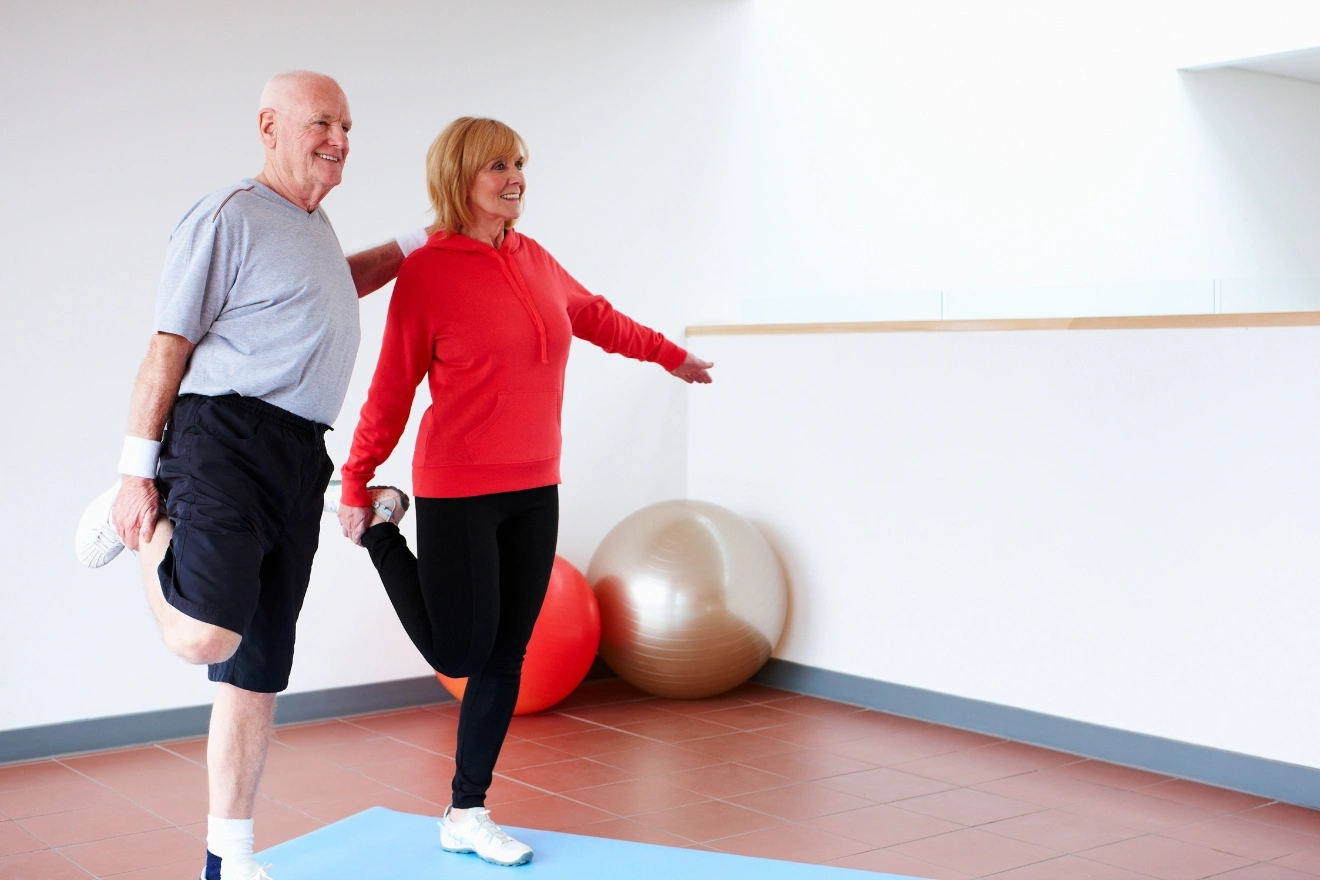
In 2022, a team of researchers from Brazil, Finland, the UK, and Australia published a study in the British Journal of Sports Medicine that made headlines around the world. They asked 1,702 adults aged 51 to 75 to perform a simple test: stand on one leg for 10 seconds without any additional support. No equipment. No lab. No technology. Just one foot on the ground, eyes open, arms at your sides.
They then tracked who lived and who died over an average follow-up of seven years.
- 1.84× HIGHER DEATH RISK IF YOU CAN’T HOLD 10 SECONDS
- 54% OF AGES 71–75 FAILED THE TEST
- 5% OF AGES 51–55 FAILED (BUT DECLINE STARTS HERE)
The findings were striking. Individuals who could not hold the single-leg stance for 10 seconds had an 84 percent higher risk of dying from any cause over the following seven years — even after adjusting for age, sex, body mass index, and pre-existing conditions. The test was independently predictive of mortality, adding meaningful information beyond what traditional clinical assessments provide.
The age-related decline was steep: only 5 percent of participants aged 51 to 55 failed the test, but 54 percent of those aged 71 to 75 could not complete it. Balance doesn’t fade gradually — it drops off a cliff in the later decades, and by the time most people notice, significant capacity has already been lost.
The 10-second one-legged stance provides rapid and objective feedback for the patient and health professionals regarding static balance, and adds useful information regarding mortality risk in middle-aged and older men and women.
– BRITISH JOURNAL OF SPORTS MEDICINE, 2022
The researchers recommended that the 10-second single-leg stance be incorporated into routine health examinations for middle-aged and older adults — alongside blood pressure, cholesterol, and body weight. It is, in effect, a vital sign for balance.
What Proprioception Actually Is
Proprioception is your body’s sixth sense — the awareness of where your limbs and body are positioned in space without having to look at them. Right now, you know where your hands are without checking. You know whether your feet are flat on the floor or crossed under your chair. You know how far your head is tilted. This awareness doesn’t come from your eyes — it comes from a vast network of specialized receptors embedded in your muscles, tendons, joint capsules, and skin.
These receptors — called mechanoreceptors — include muscle spindles (which detect changes in muscle length), Golgi tendon organs (which detect changes in muscle tension), and joint receptors (which detect the position and movement of the joint capsule). Together, they provide a continuous stream of data to the central nervous system about the position, velocity, and force being applied to every part of your body.
This information feeds into the three-system balance architecture that keeps you upright:
VISUAL SYSTEM
What you see. Horizon lines, spatial references, and depth perception that orient you in space. Dominant in well-lit, stable environments.VESTIBULAR SYSTEM
Your inner ear. Detects head position, acceleration, and angular motion. Critical for dynamic balance and movement in changing conditions.SOMATOSENSORY SYSTEM
Proprioception. Receptors in muscles, tendons, and joints that tell your brain where your body is — without you looking. The most trainable of the three.
When all three systems are functioning well, balance feels effortless — you don’t think about staying upright any more than you think about breathing. But when one system degrades — when vision dims, when the vestibular system weakens, or when proprioceptive acuity fades — the remaining systems compensate. And when two or more systems decline below their thresholds, the body can no longer maintain stability. That’s when falls begin.
Why Single-Leg Stability Is the Key Test
Human locomotion is, fundamentally, a series of controlled single-leg stances. Every step you take involves a brief moment where your entire body weight is supported by one leg while the other swings forward. Walking is falling and catching yourself, over and over, on one leg at a time.
This is why single-leg stability is such a sensitive predictor of fall risk and functional capacity. When you stand on one leg, you are testing the integration of all three balance systems simultaneously. Your visual system provides spatial orientation. Your vestibular system detects the subtle head and body sway that occurs during stance. And your proprioceptive system — the receptors in your ankle, knee, hip, and core — provides the real-time feedback that allows your muscles to make the continuous micro-adjustments that keep you upright.
Close your eyes during a single-leg stance, and you remove the visual system entirely. Now your body must rely solely on proprioception and vestibular input. This is the gold standard test for proprioceptive function — and research has shown it to be remarkably sensitive to age-related decline and remarkably responsive to training.
THE RESEARCH
A randomized controlled trial of adults aged 65 to 85 found that high-frequency proprioceptive training — just 12 sessions over six weeks — significantly improved single-stance stability by increasing proprioceptive control (p<0.001) and postural control (p<0.01). Neither treadmill training nor no intervention produced any significant change. The researchers concluded that proprioceptive training is a powerful activator of refined postural control that allows safer interaction with the ground and reduced fall risk
The Case for Starting Early
Here is the critical insight that separates this post from a generic fall-prevention guide: proprioception and single-leg stability should not be trained reactively — after a fall, after a diagnosis, after independence has already eroded. They should be trained proactively — in the decades before decline accelerates.
The data supports this urgency. Balance begins declining measurably in the mid-50s. By 71 to 75, more than half of adults can’t hold a single-leg stance for 10 seconds. But the neural pathways that govern proprioception are most responsive to training when they are still robust — in the 30s, 40s, and 50s. Like muscle reserve (Pillar 1) and aerobic capacity (Pillar 2), balance is a use-it-or-lose-it system that rewards early investment.
The analogy to the muscle savings account from Pillar 1 is direct. Every year of proprioceptive training in your 40s and 50s deposits balance capacity that you’ll draw from in your 70s and 80s. The person who enters their seventh decade with robust proprioception and practiced single-leg stability has decades of runway before they cross the threshold where balance impairment becomes dangerous. The person who enters their seventh decade with untrained balance may cross that threshold within years.
And unlike pharmaceutical interventions for fall prevention — which often come with side effects, compliance challenges, and modest effect sizes — proprioceptive training has no side effects, costs nothing, requires no equipment, and can be practiced during activities you’re already doing.
The Shoes-and-Surfaces Problem
There is a fascinating hypothesis emerging from the proprioception research that connects directly to our Pillar 3 discussion of floor sitting and functional movement. Researchers studying falls in older adults and recurrent injuries in athletes have proposed that both groups suffer from the same root cause: reduced interaction with uneven ground.
Modern life wraps our feet in cushioned shoes and routes them across uniformly flat surfaces — concrete, tile, hardwood, carpet. The proprioceptive receptors in the foot and ankle — designed to read terrain, detect slopes, and respond to the endless variability of natural ground — are effectively silenced. Over years and decades, the neural pathways that process this information degrade from disuse.
The risk of falls in older adults and the risk of recurrent injuries in athletes would have a common origin: lack of proprioceptive control consequent to reduced interaction with uneven ground. – JOURNAL OF CLINICAL MEDICINE, 2019
This is why walking barefoot on varied surfaces, training on unstable platforms, and simply spending time outdoors on natural terrain are all valuable proprioceptive stimuli. Every time your foot encounters an unexpected slope, an uneven stone, or a soft patch of ground, the proprioceptive system fires, processes, and adapts. Remove those stimuli — as modern environments systematically do — and the system atrophies.
The Progressive Single-Leg Stability Program
Building proprioception and single-leg stability doesn’t require specialized equipment or a gym membership. It requires progressive challenge — starting where you are and incrementally increasing the demand on your balance systems.
SINGLE-LEG STABILITY PROGRESSION — FROM BEGINNER TO ADVANCED
Level 1
Single-leg stance, eyes open, next to a counter or wall for safety. Hold 30 seconds per leg. Work up to 60 seconds. This is your baseline — if you can’t do this comfortably, start here.Level 2
Single-leg stance, eyes closed. This removes visual input and forces proprioception to take over. Start with 10 seconds, build to 30. This single progression is one of the most powerful balance-training tools available.Level 3
Single-leg stance on an unstable surface — a folded towel, a foam pad, or a pillow. Eyes open first, then closed. The unstable surface amplifies proprioceptive demand.Level 4
Single-leg stance with head turns, arm reaches, or catching a ball. Adding a secondary task (dual-tasking) trains the balance system to function while attention is divided — the real-world condition where most falls occur.Level 5
Dynamic single-leg work — single-leg Romanian deadlifts, single-leg hops, lateral step-downs, tandem walking with head turns. These integrate strength, balance, and proprioception into functional movement patterns.
The key principle is progressive overload — the same principle that drives adaptation in strength training (Pillar 1). When a balance challenge becomes comfortable, it’s no longer producing adaptation. The stimulus must evolve: harder surfaces, closed eyes, added tasks, dynamic movements. The proprioceptive system, like the muscular system, grows only when it is asked to do more than it currently can.
Integrating Balance Into Daily Life
One of the most practical advantages of proprioceptive training is that it can be woven into activities you’re already doing — no dedicated session required.
WHILE BRUSHING YOUR TEETH
Stand on one leg for the full two minutes. Switch legs halfway. Close your eyes for an additional challenge. This alone is a meaningful daily dose of single-leg stability training.WHILE WAITING IN LINE
Perform subtle weight shifts to one leg. Practice tandem stance (heel-to-toe). No one will notice — but your proprioceptive system will.WHILE COOKING
Stand on one leg while stirring, chopping, or waiting for water to boil. The counter is right there for safety. Cook dinner and train balance simultaneously.WHILE WALKING
Walk barefoot on grass. Choose uneven terrain over sidewalks when safe. Step on curb edges. Every surface variation stimulates the proprioceptive receptors that flat floors silence.POST-WORKOUT
Add 2 minutes of single-leg stance (eyes closed) at the end of any Pillar 1 or Pillar 2 session. Fatigued muscles amplify the proprioceptive challenge — making this the most productive balance window.DURING PHONE CALLS
Stand on one leg for the duration of the call. Switch legs every few minutes. The conversation provides a natural dual-task challenge that makes the balance training more functional.
The Connection to Every Pillar
Proprioception and single-leg stability sit at the intersection of everything we’ve built in this series. They require the leg strength from Pillar 1 — you cannot hold a single-leg stance if your muscles are too weak to support your body weight. They benefit from the cardiovascular fitness of Pillar 2 — fatigue degrades proprioceptive acuity. They depend on the mobility of Pillar 3 — ankle dorsiflexion, hip rotation, and thoracic mobility all contribute to the range of motion available for balance corrections.
And they are the specific, trainable skill that Pillar 4 is built on: the ability to detect, process, and respond to perturbations — the stumble on a curb, the slip on a wet floor, the push from a crowd — before they become falls.
The 10-second test is the diagnostic. The single-leg progression is the prescription. And the daily integration is how you make it a permanent part of your life without adding a single minute to your schedule.
THE BOTTOM LINE
Proprioception — your body’s ability to sense where it is in space — is the invisible foundation of balance. Single-leg stability is its most practical and testable expression. A 2022 study of 1,702 adults found that inability to hold a single-leg stance for 10 seconds carries an 84 percent higher risk of death from any cause over the following seven years. Yet proprioception is among the most trainable physical capacities — a six-week high-frequency program significantly improved single-stance stability in adults aged 65 to 85 (p<0.001). The argument for starting early is the same one we’ve made for muscle reserve, cardiovascular fitness, and mobility: the systems you train in your 40s and 50s are the systems that protect you in your 70s and 80s. Start now. Stand on one leg. Close your eyes. And build the balance reserves your future self will need.