


Throughout Pillar 4, we’ve established two foundational truths. First, falls are the leading cause of injury-related death in older adults — a crisis that is accelerating, not receding. Second, the proprioception and single-leg stability that prevent falls are trainable skills that respond to practice at any age, but reward early and consistent investment most generously.
Now we arrive at the question that matters most: what, specifically, should you do — and how do you make it stick?
The answer is simultaneously the simplest and most important conclusion of this entire series. The most effective balance training program is the one you actually do. Not the theoretically optimal regimen performed three times and abandoned. Not the sophisticated protocol that requires a gym, a trainer, and an hour of dedicated time. The one you do — every single day, without thinking about it, because it’s woven into habits you already have.
Research consistently supports this approach. A review of fall prevention literature found that consistency trumps intensity in balance training — fifteen minutes daily produces better outcomes than one hour weekly. The reason is neurological: balance is a motor skill, and motor skills are maintained through frequent repetition, not occasional intensity. Your brain needs daily proprioceptive input to maintain the neural pathways that keep you upright, the same way a language needs daily use to remain fluent.
The Habit-Stacking Approach
The most reliable way to build a new habit is to attach it to an existing one. This principle — known as habit stacking — was popularized by behavioral researchers studying how small behaviors become automatic. Instead of creating a new block of time for “balance training,” you attach balance challenges to routines you already perform every day without fail.
The beauty of this approach is that it eliminates the two biggest barriers to exercise adherence: time and motivation. You don’t need to find time because you’re using time you’re already spending. You don’t need motivation because the trigger is automatic — you brush your teeth every morning regardless of how you feel, and now your balance training lives inside that habit.
MORNING — BRUSHING TEETH
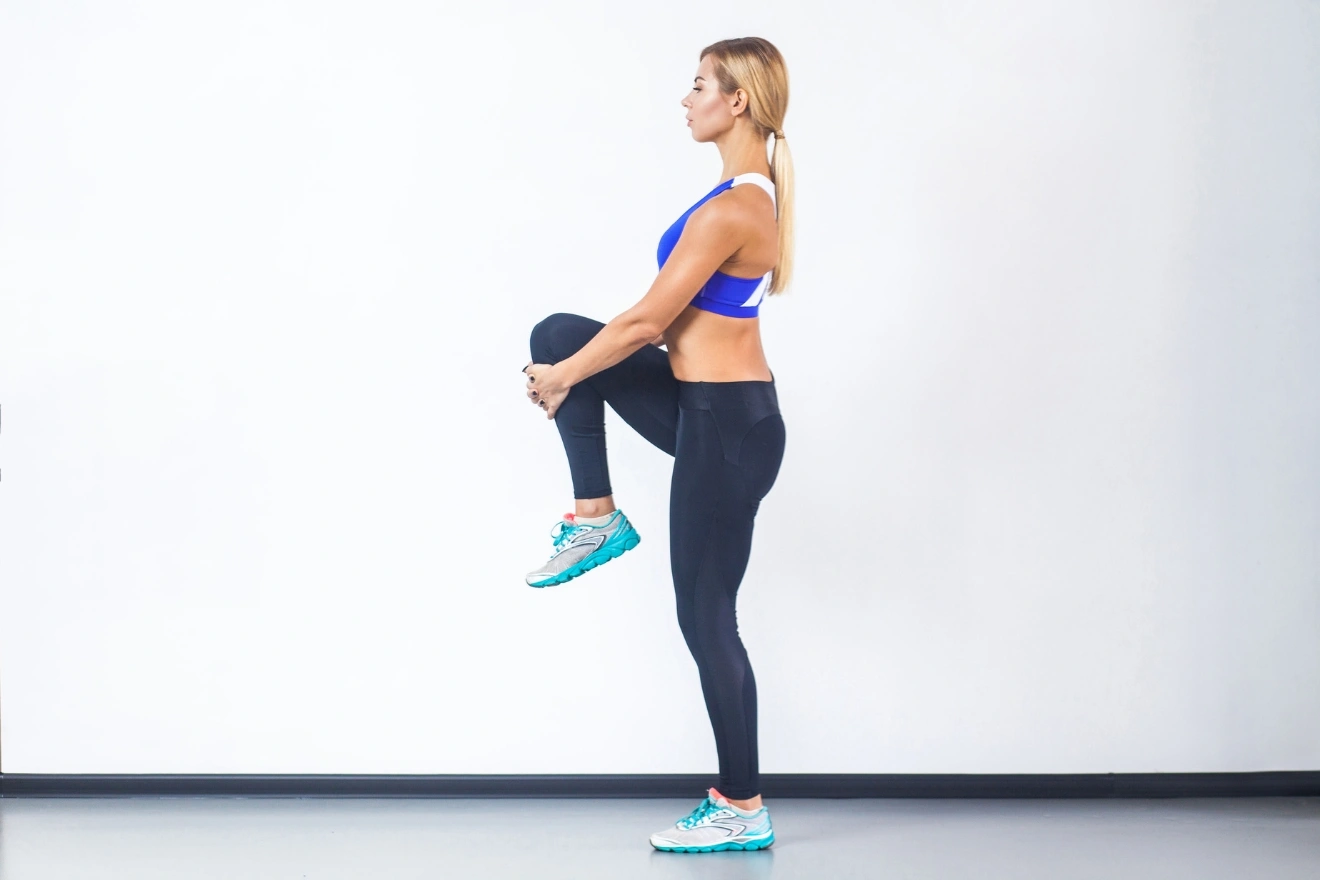
Single-leg stance, 2 minutes
Stand on your left leg for the first minute, right leg for the second. The counter is right there for safety. Progress to eyes closed when ready. You do this twice daily — that’s 4 minutes of single-leg training without adding a second to your schedule.MORNING — WAITING FOR COFFEE
Heel raises + tandem stance
While the coffee brews, perform 20 slow heel raises (strengthens calves and ankles), then stand in tandem position (heel-to-toe) for 30 seconds per foot. The kitchen counter provides support. Total: 2 minutes.AFTERNOON — PHONE CALLS
Single-leg stance with dual-task
Stand on one leg for the duration of any phone call. Switch legs every few minutes. The conversation is the dual-task challenge — training your balance system to function while your attention is divided. This is how real falls happen.EVENING — COOKING DINNER
Single-leg stance while stirring
Stand on one leg while stirring a pot, chopping vegetables (with the knife safely on the counter between cuts), or waiting for water to boil. The counter provides security. Kitchen balance training accumulates minutes quickly.EVENING — WATCHING TV
Floor sitting + sit-to-rise transitions
Replace 20 minutes of couch time with floor sitting. Change positions every few minutes. During commercial breaks (or between episodes), practice sitting down and standing up without using your hands. Two critical skills maintained without leaving the living room.ANYTIME — WAITING IN LINE
Weight shifts + tandem stance
At the grocery store, the bank, the post office — subtly shift your weight to one leg. Practice tandem stance (heel-to-toe). No one will notice. Your proprioceptive system will.
Add these up and you have ten to fifteen minutes of balance training per day — without dedicating a single minute to “exercise.” No gym required. No special equipment. No workout clothes. Just attention, layered onto the architecture of your existing day.
The Uneven Surface Principle
Your proprioceptive system was designed for a world without flat floors. For hundreds of thousands of years, human feet navigated uneven terrain — dirt paths, rocky hillsides, grassy fields, sandy beaches, forest floors. Every step required the proprioceptive receptors in the feet and ankles to read the surface, adjust the muscles, and maintain balance through constant, unconscious micro-corrections.
Modern life has eliminated nearly all of this variability. Concrete, tile, hardwood, carpet — every surface you walk on is uniformly flat, predictable, and proprioceptively boring. Your feet are encased in cushioned shoes that further dampen sensory input. The result is a progressive dulling of the very system that keeps you upright — the neurological equivalent of putting your balance in a sensory deprivation chamber for decades.
The fix is to deliberately reintroduce surface variability into your daily life.
GRASS
Walk barefoot on your lawn. The soft, uneven surface activates proprioceptors that flat floors silence. Even 5 minutes daily makes a measurable difference.GRAVEL PATHS
Seek out gravel or packed-earth walking paths. The variable texture forces your ankles and feet to adapt constantly — the exact stimulus proprioception needs.SAND
Beach walking is a powerful proprioceptive challenge. The yielding, shifting surface demands continuous stabilization from the entire kinetic chain.FOAM PAD
A $15 foam balance pad simulates uneven terrain indoors. Stand on it during any habit-stacked exercise to amplify proprioceptive demand.FOLDED TOWEL
No equipment needed. A folded bath towel under your feet creates enough instability to challenge your balance system meaningfully.CURB WALKING
Walk along the edge of a curb (heel-to-toe) when safe to do so. The narrow surface, slight elevation, and visual challenge combine for an excellent balance drill.
The principle is simple: any surface that is not perfectly flat, predictable, and stable is a balance training surface. Seek them out rather than avoiding them. Walk on the grass instead of the sidewalk. Choose the gravel path over the paved one. Take your shoes off in the backyard. Every variable surface is a proprioceptive stimulus that your neural pathways will use to maintain the balance capacity that flat floors are quietly eroding.
Structured Balance Training: The 10-Minute Daily Protocol
For those who want a more structured approach — or who want to accelerate their balance development beyond what habit stacking alone provides — a dedicated daily protocol can be remarkably effective in as little as ten minutes.
Minutes 1–2: Single-leg stance. Stand on one leg, arms at your sides, for 30 seconds. Switch legs. Repeat. If this is easy, close your eyes. If that’s easy, stand on a folded towel or foam pad with eyes closed. Always have a wall or counter within arm’s reach.
Minutes 3–4: Tandem walking. Walk heel-to-toe in a straight line for 20 steps. Turn around and return. This trains the narrow base of support that is most challenging for balance and most relevant to real-world fall scenarios — navigating tight spaces, stepping through doorways, walking on uneven paths.
Minutes 5–6: Heel raises and toe raises. Stand with feet hip-width apart and slowly rise onto your toes, hold for 2 seconds, then lower. Repeat 15 times. Then lift your toes off the ground (rocking back onto your heels) and hold for 2 seconds. Repeat 10 times. These strengthen the ankle stabilizers that are first responders in any balance perturbation.
Minutes 7–8: Lateral weight shifts and step-overs. Stand with feet wide apart and shift your weight fully over one leg, lifting the opposite foot slightly. Hold 3 seconds, shift to the other side. Then place a rolled towel on the floor and step over it laterally, back and forth, 10 times each direction. This trains frontal-plane balance — the side-to-side stability that prevents lateral falls, which are among the most dangerous.
Minutes 9–10: Clock reaches. Stand on one leg and reach the other foot forward (12 o’clock), to the side (3 or 9 o’clock), and behind you (6 o’clock), tapping the ground lightly each time. Five reaches in each direction per leg. This dynamic, multi-directional challenge integrates strength, balance, and proprioception into a single exercise that mimics the unpredictable demands of real-world movement.
THE RULE THAT MAKES IT WORK
Consistency beats intensity. Ten minutes every day is more effective than an hour once a week. Balance is a neural skill — it needs daily input to maintain and improve. The moment it becomes a habit rather than a workout, you’ve won. You’ll do it for the rest of your life not because you’re disciplined, but because it’s simply part of how you live.
Who This Is For (Everyone)
Balance training is not just for older adults. It is for everyone — and the argument for starting early is one of the most consistent themes across all four pillars.
If you are in your 20s or 30s, balance training maintains the proprioceptive capacity you currently take for granted and prevents the silent neural decline that begins in the mid-50s. It also reduces your risk of ankle sprains, ACL tears, and other injuries that are driven by poor proprioceptive control — the same root cause that drives falls in older adults.
If you are in your 40s or 50s, you are in the critical window where balance capacity begins to decline measurably but is still highly responsive to training. Every day of proprioceptive training during this decade deposits balance reserves that you’ll draw from in your 70s and 80s.
If you are in your 60s or older, balance training is the single most protective intervention against falls — the leading cause of injury-related death in your age group. A 2025 systematic review of 27 randomized controlled trials found that exercise programs incorporating balance training reduce fall incidence by 20 to 75 percent. The evidence is among the strongest in all of preventive medicine.
The Four Pillars: Complete
This post concludes Pillar 4 — and with it, the entire 4 Pillars of Long-Term Physical Health series. Over the course of fifteen posts, we’ve built a comprehensive, evidence-based framework for maintaining physical function, independence, and vitality across a lifetime.
THE 4 PILLARS — COMPLETE FRAMEWORK
Pillar 1 — Strength
Muscle as endocrine organ. Muscle reserve. Minimum effective dose. Bone density. Compound lifts 2–3× per week.Pillar 2 — Cardio
VO2 max as survival predictor. Zone 2 aerobic base. HIIT for cardiovascular ceiling. 3–4 sessions per week.Pillar 3 — Mobility
Joint health. Stretching, yoga, movement variety. Posture correction. Floor sitting and hip hinges. 5 min daily + 2–3 yoga sessions.Pillar 4 — Balance
Fall prevention. Proprioception. Single-leg stability. Daily habit-stacked balance training. 10–15 min woven into existing routines.
Together, these four pillars address every major modifiable risk factor for age-related physical decline: sarcopenia, bone loss, cardiovascular disease, metabolic dysfunction, joint degeneration, postural deterioration, mobility restriction, and falls. They require no gym membership, no expensive equipment, and no elaborate programming. They require only consistency — the daily, decade-spanning commitment to moving your body through the full range of what it was designed to do.
The 4 Pillars framework is not a fitness program. It is a longevity program — built on the simple premise that the body you maintain today is the body you’ll live in tomorrow. Every squat, every walk, every stretch, every single-leg stance is a vote for the person you want to be at 80.
What’s Next: Recovery — The Often-Ignored Multiplier
The four pillars describe what to do. But there is a force multiplier that determines how effectively your body adapts to the training stimulus — and most people systematically neglect it.
Next week, we begin a new chapter: Recovery: The Often-Ignored Multiplier. Sleep, nutrition, stress management, and the science of adaptation — the mechanisms that turn training into transformation. Because the work you do in the gym, on the walk, on the floor, and on one leg only becomes strength, endurance, mobility, and balance if your body has the resources and the time to rebuild.
The pillars are built. Now we learn how to maintain them.
THE BOTTOM LINE
The most effective balance training program is the one you actually do — every day, without thinking about it. Habit-stack single-leg stands onto tooth brushing, phone calls, and cooking. Seek out uneven surfaces that challenge your proprioception. Add a 10-minute daily protocol for structured progression. Consistency beats intensity: fifteen minutes daily outperforms one hour weekly. Balance is a neural skill that requires daily input to maintain. Start now — regardless of your age — because the deposits you make today are the reserves you’ll draw from when a stumble becomes the difference between catching yourself and hitting the ground. The four pillars are complete. Your body was designed to be strong, to endure, to move freely, and to stay upright. All it needs is the daily reminder that you still expect it to.