

Introduction
The gut is often called the “second brain” — and for good reason. Roughly 70% of your immune system lives in your gastrointestinal tract, and the network of neurons lining your gut rivals the complexity of your spinal cord. At Prell Integrative Physical Therapy, we recognize that recovery, inflammation, pain, and even mental resilience are all deeply connected to what’s happening in your digestive system. Understanding gut health isn’t just for gastroenterologists — it belongs in every conversation about whole-person wellness.
01 — What Is the Gut Microbiome?
Your gastrointestinal tract is home to a vast community of microorganisms — bacteria, viruses, fungi, and other microbes — collectively known as the gut microbiome. These organisms aren’t just passengers; they are active participants in virtually every system in your body.
Key facts:
- 38 trillion estimated microbial cells in the human body — roughly equal to the number of human cells
- 1,000+ species of bacteria can reside in the human gut
- 70% of your immune system is housed in gut-associated lymphoid tissue (GALT)
A healthy, diverse microbiome supports digestion, produces essential vitamins (including vitamin K and several B vitamins), regulates inflammation, and communicates with nearly every organ system in the body. When that balance is disrupted — a state called dysbiosis — the consequences extend well beyond the digestive tract.
What is dysbiosis? Dysbiosis refers to an imbalance in the composition of gut microbes — too many harmful species, too few beneficial ones, or reduced overall diversity. It can be triggered by antibiotics, chronic stress, poor diet, infections, and even lack of sleep.
02 — The Systemic Effects of Gut Health
The influence of the gut microbiome extends to virtually every system in the body. Here’s what the current evidence tells us:
Brain & Mental Health – The gut-brain axis allows constant two-way communication. Gut bacteria produce neurotransmitters including serotonin — about 90% of the body’s supply is made in the gut.
Immune Function – The gut trains immune cells to distinguish friend from foe. Dysbiosis is linked to autoimmune conditions, chronic inflammation, and increased susceptibility to infection.
Bone Health – Gut bacteria influence calcium and magnesium absorption. Certain short-chain fatty acids produced by gut microbes support bone mineral density directly.
Muscle & Recovery – Emerging research links gut health to muscle protein synthesis, exercise recovery, and chronic musculoskeletal pain through inflammatory pathways.
Cardiovascular Health – Gut microbes metabolize certain foods into compounds that affect blood pressure, cholesterol levels, and arterial inflammation.
Metabolism & Weight – The microbiome influences how efficiently calories are extracted from food and regulates hormones like leptin and ghrelin that control hunger and satiety.
03 — The Gut-Brain Axis
Perhaps the most remarkable — and underappreciated — aspect of gut health is its intimate relationship with the brain. The gut-brain axis is a bidirectional communication network connecting the central nervous system with the enteric nervous system (the “gut brain”) via the vagus nerve, immune signaling, and circulating metabolites.
How it communicates:
- Gut Microbiome → Vagus Nerve → Brain (signals travel both directions)
- Gut Bacteria → Neurotransmitters → Mood & Cognition (gut bacteria produce serotonin, dopamine precursors, GABA, and other neuroactive compounds)
This connection helps explain why gut dysbiosis is associated with anxiety, depression, brain fog, and fatigue — symptoms that many physical therapy patients report alongside their musculoskeletal complaints. It also explains why chronic psychological stress so often triggers digestive symptoms: the communication runs both ways.
04 — Gut Health, Leaky Gut, and Inflammation
One of the most clinically significant concepts in gut health is intestinal permeability — sometimes called “leaky gut.” The lining of your small intestine is only one cell thick, and it acts as a selective barrier: letting nutrients through while keeping pathogens, toxins, and undigested food particles out.
When this barrier is compromised — by chronic stress, a diet high in processed foods, alcohol, certain medications, or infection — unwanted substances can pass into the bloodstream, triggering an immune response. This leads to systemic, low-grade inflammation that has been implicated in a wide range of conditions:
- Chronic musculoskeletal pain — inflammatory cytokines sensitize pain pathways throughout the body
- Autoimmune conditions — rheumatoid arthritis, psoriasis, ankylosing spondylitis
- Metabolic syndrome — insulin resistance, obesity, type 2 diabetes
- Mood disorders — anxiety and depression linked to neuroinflammation
- Fatigue and post-exertional malaise — including patterns seen in fibromyalgia and long COVID
- Skin conditions — eczema, acne, and rosacea have well-established gut connections
Important note: “Leaky gut” as a clinical diagnosis remains an area of active research. While intestinal permeability is real and measurable, its role in specific diseases is still being established. If you suspect gut-related issues, work with a qualified gastroenterologist or functional medicine physician.
05 — Gut Health and Physical Therapy Recovery
You might be wondering: what does my gut have to do with my knee pain or my shoulder rehab? More than you might think.
At Prell Integrative Physical Therapy, we see patients whose recovery trajectories are influenced by factors that go beyond the injury itself. Here’s how gut health specifically intersects with rehabilitation:
- Inflammation regulation. A healthy gut helps modulate the inflammatory response that follows injury. Dysbiosis can tip the balance toward chronic, unresolved inflammation — slowing tissue healing and amplifying pain.
- Nutrient absorption. All of the nutritional foundations we’ve discussed in this series — calcium, vitamin D, magnesium, and others — depend on a healthy gut lining to be properly absorbed. A compromised gut undermines even the best diet.
- Muscle protein synthesis. Emerging research suggests that gut bacteria influence how efficiently the body uses dietary protein for muscle repair and growth — directly relevant to anyone in rehabilitation.
- Sleep quality. The gut-brain axis influences sleep architecture. Poor sleep dramatically impairs tissue repair, pain tolerance, and motivation to engage with therapy.
- Mental resilience. Recovery from injury is as much psychological as physical. Gut health influences anxiety, mood, and cognitive function — all of which affect a patient’s engagement, consistency, and outcomes in physical therapy.
06 — What Harms and What Helps the Microbiome
What Disrupts Gut Health
- Ultra-processed foods — high in refined sugars, artificial additives, and emulsifiers that damage the gut lining and reduce microbial diversity
- Antibiotics — necessary when prescribed, but they indiscriminately reduce microbial diversity; always follow up with probiotic-rich foods
- Chronic psychological stress — alters gut motility, gut barrier function, and microbial composition via the gut-brain axis
- NSAIDs and PPIs — long-term use can alter gut microbiome composition and damage the gut lining
- Sedentary lifestyle — regular physical activity is independently associated with greater microbial diversity
- Poor sleep — disrupts the circadian regulation of gut microbes, which have their own daily rhythms
- Excessive alcohol — damages gut epithelial cells and promotes dysbiosis
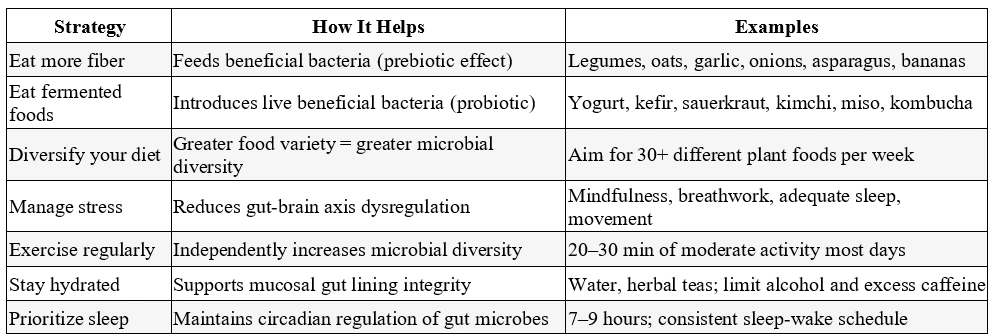
What Supports Gut Health
07 — A Word on Probiotics and Prebiotics
Probiotics Probiotic supplements contain live beneficial bacteria. The evidence for their use is strain-specific and condition-specific — meaning a probiotic that helps with antibiotic-associated diarrhea may do nothing for irritable bowel syndrome or anxiety. Look for:
- Strains with research behind them for your specific concern (Lactobacillus rhamnosus GG, Bifidobacterium longum, etc.)
- Products with at least 1–10 billion CFUs (colony-forming units)
- Refrigerated storage or enteric coating to ensure survivability
- Third-party testing for quality verification
Prebiotics Prebiotics are non-digestible fibers that feed your existing beneficial bacteria. They are often more impactful than probiotic supplements because they nourish the microbiome you already have. Rich prebiotic sources include inulin (chicory root, garlic, leeks), fructooligosaccharides (onions, asparagus), and resistant starch (cooked and cooled potatoes, green bananas, legumes).
Synbiotics Some products combine both pre- and probiotics — these are called synbiotics and may offer synergistic benefits. As with all supplements, food-first approaches are generally superior.
Bottom line: Food-derived probiotics and prebiotics have consistently stronger evidence than most commercial supplements. Always consult your physician before beginning any probiotic regimen if you are immunocompromised.
08 — Practical Steps to Support Your Gut
- Eat the rainbow. Aim for at least 30 different plant foods each week — not just servings, but varieties. Each plant species feeds different microbial communities.
- Add one fermented food daily. A serving of yogurt, kefir, kimchi, or sauerkraut is one of the simplest evidence-based steps for microbiome support.
- Prioritize fiber over supplements. Most Americans consume less than half the recommended 25–38 grams of fiber per day. Increase gradually to avoid discomfort.
- Move your body regularly. Physical activity is one of the most consistent predictors of a healthy, diverse microbiome — and it’s free.
- Protect your sleep. Treat 7–9 hours of consistent sleep as non-negotiable. Your gut microbiome has its own circadian rhythm, and disrupting yours disrupts theirs.
- Reduce processed food gradually. Replacing one processed snack with a whole-food option daily adds up significantly over time.
- Manage stress actively. Chronic stress is one of the most underappreciated drivers of gut dysbiosis. Whatever your stress management practice — exercise, breathwork, therapy, time in nature — protect it.
- Be thoughtful with medications. Have a conversation with your physician about gut-protective strategies when taking antibiotics, NSAIDs, or PPIs long-term.
References
- Sender R, et al. Revised Estimates for the Number of Human and Bacteria Cells in the Body. Cell. 2016; 164(3):337–340.
- Cryan JF, et al. The Microbiota-Gut-Brain Axis. Physiol Rev. 2019; 99(4):1877–2013.
- Sonnenburg JL, Bäckhed F. Diet-microbiota interactions as moderators of human metabolism. Nature. 2016; 535:56–64.
- Wastyk HC, et al. Gut-microbiota-targeted diets modulate human immune status. Cell. 2021; 184(16):4137–4153.
- Clarke SF, et al. Exercise and associated dietary extremes impact on gut microbial diversity. Gut. 2014; 63(12):1913–1920.
- Carabotti M, et al. The gut-brain axis: interactions between enteric microbiota, central and enteric nervous systems. Ann Gastroenterol. 2015; 28(2):203–209.
- National Institutes of Health. Your Digestive System & How It Works. NIDDK.