



Introduction
Here is an uncomfortable truth: the modern food environment is not neutral. Ultra-processed foods — which now account for more than half of the average American’s daily caloric intake — are specifically engineered to be hyper-palatable, to override satiety signals, and to keep you eating beyond what your body needs. At Prell Integrative Physical Therapy, we’ve watched this play out clinically: patients who struggle with inflammation, slow recovery, weight management, and energy levels often have one thing in common — a diet dominated by ultra-processed products. The encouraging news is that most adults still have meaningful metabolic flexibility — a window of opportunity to course-correct before chronic disease takes hold. This guide explains what that means and exactly how to act on it.
What Are Ultra-Processed Foods?
The term “ultra-processed” comes from the NOVA classification system, developed by Brazilian researchers to categorize foods not by their nutrients, but by the degree and purpose of their industrial processing. It has become one of the most widely cited frameworks in nutrition science.
The NOVA Classification System
NOVA Group 1 — Unprocessed Fruits, vegetables, eggs, plain meat, milk, legumes
NOVA Group 2 — Minimally Processed Canned tomatoes, frozen vegetables, plain yogurt, oats, olive oil
NOVA Group 3 — Processed Cheese, cured meats, canned fish in oil, freshly baked bread
NOVA Group 4 — Ultra-Processed Packaged snacks, soft drinks, instant noodles, breakfast cereals, most fast food
NOVA Group 4 ultra-processed foods (UPFs) are industrial formulations made mostly from refined substances extracted from foods — oils, fats, starches, sugars, proteins — and combined with additives that have no culinary use: emulsifiers, flavor enhancers, artificial colors, preservatives, and texturizers. They are designed in laboratories to maximize palatability and consumption, not nutrition.
The scale of the problem: Studies estimate that ultra-processed foods now account for 57–60% of total daily calories for the average American adult — and up to 67% for children and adolescents. These are not occasional indulgences; for many people, they are the dietary baseline.
How to Spot an Ultra-Processed Food
A useful rule of thumb: if it contains an ingredient you wouldn’t find in a home kitchen — or if the ingredient list reads more like a chemistry textbook than a recipe — it’s almost certainly ultra-processed. Common markers include:
- Five or more ingredients, especially with chemical-sounding names
- Hydrogenated or partially hydrogenated oils
- High-fructose corn syrup, maltodextrin, or dextrose
- Emulsifiers: carrageenan, polysorbate 80, soy lecithin
- Artificial flavors, colors (e.g. Red 40, Yellow 5), or sweeteners
- Preservatives: sodium benzoate, BHA, BHT, TBHQ
- Protein isolates and hydrolyzed proteins
What Ultra-Processed Foods Do to Your Body
Key statistics:
- 32% higher risk of all-cause mortality associated with high UPF consumption (BMJ, 2019)
- 500+ extra calories per day consumed when given unrestricted access to ultra-processed foods vs. whole foods (NIH, 2019)
- 10% increase in UPF consumption associated with a 12% higher risk of type 2 diabetes (Diabetologia, 2020)
Ultra-processed foods harm health through several overlapping mechanisms — and understanding them is the key to understanding why willpower alone is rarely sufficient to resist them.
They Override Satiety Signals Whole foods trigger the release of satiety hormones (leptin, GLP-1, PYY) that tell your brain you’ve had enough. UPFs — engineered to deliver precise combinations of fat, sugar, and salt — bypass these signals by hitting reward pathways in the brain before the stomach has time to register fullness. This is why it is genuinely difficult to eat just one chip.
They Disrupt the Gut Microbiome UPFs are low in fiber, high in additives, and contain emulsifiers (like polysorbate 80 and carboxymethylcellulose) that have been shown in animal studies to directly damage the gut lining and disrupt microbial balance — contributing to dysbiosis and systemic inflammation.
They Drive Chronic Low-Grade Inflammation Refined carbohydrates and industrial seed oils shift the body’s ratio of omega-6 to omega-3 fatty acids, promoting a pro-inflammatory state. This chronic inflammation is the common thread linking UPF consumption to cardiovascular disease, metabolic syndrome, joint pain, and impaired healing.
They Impair Insulin Sensitivity The rapid blood sugar spikes generated by refined carbohydrates and added sugars demand repeated surges of insulin. Over time, cells become less responsive to insulin’s signal — a process called insulin resistance — which is the gateway to type 2 diabetes, weight gain, and metabolic dysfunction.
They Crowd Out Nutrient-Dense Foods Every calorie of ultra-processed food consumed is a calorie that didn’t come from a food that provides vitamins, minerals, fiber, antioxidants, and phytonutrients. UPFs deliver energy without nourishment — a pattern sometimes called “empty calories.”
What Is Metabolic Flexibility — and Why It Matters
Metabolic flexibility is your body’s ability to efficiently switch between fuel sources — primarily glucose (from carbohydrates) and fatty acids (from fat) — based on availability and demand. It’s a fundamental marker of metabolic health, and it’s one of the first things eroded by a diet high in ultra-processed foods and refined carbohydrates.
Signs of Good Metabolic Flexibility You can go several hours between meals without energy crashes, brain fog, or irritability. You feel energized after moderate exercise. Your hunger signals arrive gradually and feel manageable. You sleep soundly and wake rested.
Warning Signs of Metabolic Inflexibility You experience strong cravings, irritability, or shakiness when meals are delayed. You feel sluggish after eating. You rely on caffeine and sugar to sustain energy throughout the day. You experience afternoon energy crashes, poor sleep, and difficulty losing weight despite reasonable effort.
Why the Window Matters Metabolic flexibility is easier to preserve than to restore. Once insulin resistance becomes established, correcting it requires sustained effort over months to years. Acting while your metabolism is still responsive — before chronic disease takes hold — is significantly more effective than trying to reverse damage later.
The connection to physical therapy is direct: metabolic flexibility affects how well your body heals, how efficiently your muscles recover, how your joints tolerate inflammation, and how much energy you have to engage with rehabilitation.
Why It’s Hard to Stop — and Why That’s Not a Character Flaw
Before diving into solutions, it’s worth acknowledging something important: the difficulty of avoiding ultra-processed foods is not a failure of discipline. It is the predictable result of a food environment engineered by some of the world’s largest companies using decades of research specifically designed to maximize consumption.
What Whole Foods Do
- Trigger gradual satiety hormone release
- Require more chewing (slows eating, aids digestion)
- Provide fiber that feeds gut bacteria
- Deliver stable, sustained energy
- Support the body’s natural appetite regulation
What Ultra-Processed Foods Do
- Hit dopamine reward pathways immediately
- Dissolve quickly, bypassing fullness signals
- Contain additives that disrupt gut bacteria
- Cause rapid blood sugar spikes and crashes
- Override the body’s natural “stop eating” signals
This matters because the solution is not about trying harder — it’s about changing your environment and defaults so that the path of least resistance leads to better choices. Willpower is a finite resource; food environment design is not.
The food industry spends billions annually on research into optimal bliss points — the precise combinations of sugar, fat, salt, and texture that maximize consumption. Competing with that using willpower alone is an unfair fight. The strategies below are designed to change the game, not just try harder at the same game.
Practical Strategies to Reduce Ultra-Processed Food Consumption
Start With Your Environment, Not Your Willpower
The single most effective change most people can make is not buying ultra-processed foods in the first place. What isn’t in your home can’t be eaten impulsively. This requires a shift in thinking: the critical decision point is the grocery store, not the pantry at 9pm.
1. Shop the perimeter. The outer aisles of most grocery stores contain whole foods — produce, meat, dairy, eggs, seafood. The inner aisles are where the ultra-processed products live. This isn’t coincidental; it’s designed that way.
2. Never shop hungry. Hunger activates the brain’s reward circuitry, making hyper-palatable foods significantly more appealing. Eat before you shop, or at least have a snack beforehand.
3. Use a list and stick to it. Supermarkets are carefully designed to encourage impulse purchases. A detailed shopping list reduces exposure to UPF marketing and end-cap displays.
4. Batch cook once or twice a week. The most common trigger for reaching for ultra-processed foods is not craving — it’s convenience. When whole-food meals are already prepared and accessible, the convenience equation shifts.
5. Make whole foods visible. Keep a bowl of fruit on the counter. Pre-cut vegetables at eye level in the fridge. Nuts in a visible jar. We eat what we see.
6. Redesign your snack defaults. Replace packaged snacks with whole-food alternatives that are equally convenient: hard-boiled eggs, cheese, fruit, nuts, Greek yogurt, cut vegetables with hummus.
The Practical Swap Strategy
Wholesale dietary overhauls rarely stick. The most sustainable approach is systematic, gradual substitution — replacing one ultra-processed item at a time with a whole-food equivalent.
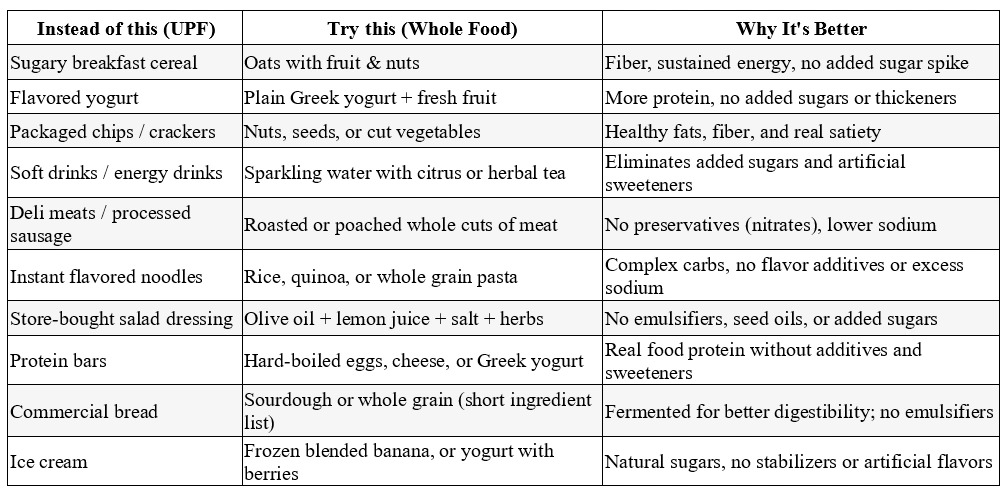
06 — Reading Labels Without Getting Overwhelmed
Food labels are intentionally complex. Marketing claims on the front of packaging (“natural,” “wholesome,” “made with real ingredients”) are largely unregulated and often misleading. The ingredient list tells the real story.
A Simple 3-Step Label Check
- Count the ingredients. More than five ingredients is a yellow flag. More than ten is a red one — especially for something that should be simple (bread, yogurt, peanut butter).
- Check the first three ingredients. Ingredients are listed in descending order by weight. If sugar, a refined grain, or an industrial oil appears in the first three, that product is nutritionally dominated by those ingredients regardless of front-label claims.
- Scan for red-flag additives. High-fructose corn syrup, hydrogenated oils, artificial colors (anything with a number), carrageenan, polysorbate 80, sodium benzoate, BHA, BHT. If you see these, put it back.
What About “Healthy” UPFs? The health food market is full of ultra-processed products dressed in wellness branding: protein bars, “superfood” snacks, plant-based meat alternatives, vitamin-fortified waters. Many carry the same additives, seed oils, and isolated protein concentrates as their less glamorous counterparts. Apply the same label-reading process regardless of health claims.
Progress Over Perfection — A Sustainable Approach
Eliminating all ultra-processed foods permanently is an unrealistic goal for most people, and pursuing perfection often leads to an all-or-nothing relationship with food that is itself unhealthy. The goal is not purity — it’s shifting your dietary baseline so that whole foods are the norm and ultra-processed foods are the exception.
The 80/20 Framework: If 80% of your dietary intake comes from minimally processed, whole foods, the remaining 20% of flexibility will have negligible negative effects on your metabolic health. The research on dietary patterns consistently shows that overall composition matters far more than occasional deviations.
Principles that support sustainable change:
- Don’t moralize food. Labeling foods as “good” or “bad” creates shame and guilt cycles that undermine long-term behavior change. Think in terms of frequency and proportion instead.
- Address food stress separately. Chronic stress is one of the primary drivers of ultra-processed food cravings. Stress management and sleep are therefore nutritional strategies, not just wellness platitudes.
- Make changes one at a time. Pick one swap and make it automatic before introducing the next. Sequential, small changes outperform simultaneous wholesale overhauls.
- Cook more, even imperfectly. Home-cooked meals from basic ingredients are almost always less processed than restaurant or packaged equivalents, even when the recipe isn’t particularly “healthy.”
Ultra-Processed Foods and Your Physical Therapy Outcomes
At Prell Integrative Physical Therapy, we see the clinical consequences of a UPF-dominated diet regularly — not as a moral judgment, but as a practical reality that shapes what is possible in rehabilitation:
- Chronic inflammation. A diet high in refined carbohydrates and industrial oils sustains the inflammatory state that slows tissue healing, amplifies pain perception, and prolongs recovery timelines.
- Impaired nutrient delivery. The minerals and vitamins discussed throughout this series — calcium, vitamin D, magnesium — depend on a functioning gut and stable metabolism to be absorbed and utilized. UPFs undermine both.
- Reduced muscle quality. Insulin resistance impairs muscle protein synthesis and accelerates muscle loss (sarcopenia), making rehabilitation harder and fall risk higher in older adults.
- Energy and motivation. Blood sugar dysregulation produces the afternoon fatigue, brain fog, and low motivation that make consistent engagement with a rehabilitation program genuinely difficult.
- Weight and joint load. Excess body weight driven by overconsumption of hyper-palatable UPFs increases mechanical load on joints — particularly the knees, hips, and lumbar spine — directly affecting pain levels and functional capacity.
None of this means nutrition is more important than skilled physical therapy. But it does mean that what you eat between sessions shapes the substrate your physical therapist has to work with. Nutrition and movement are partners, not competitors.
References
1. Monteiro CA, et al. Ultra-processed foods: what they are and how to identify them. Public Health Nutr. 2019; 22(5):936–941.
2. Hall KD, et al. Ultra-Processed Diets Cause Excess Calorie Intake and Weight Gain. Cell Metabolism. 2019; 30(1):67–77.
3. Srour B, et al. Ultra-processed food intake and risk of cardiovascular disease. BMJ. 2019; 365:l1451.
4. Narayan KMV, et al. Ultra-processed food consumption and type 2 diabetes incidence. Diabetologia. 2020.
5. Chassaing B, et al. Dietary emulsifiers impact the gut microbiota. Nature. 2015; 519:92–96.
6. Goodpaster BH, Sparks LM. Metabolic Flexibility in Health and Disease. Cell Metabolism. 2017; 25(5):1027–1036.
7. Wansink B. Environmental factors that increase food intake. Annu Rev Nutr. 2004; 24:455–479.
8. Monteiro CA, et al. NOVA. The star shines bright. World Nutrition. 2016; 7(1–3):28–38.